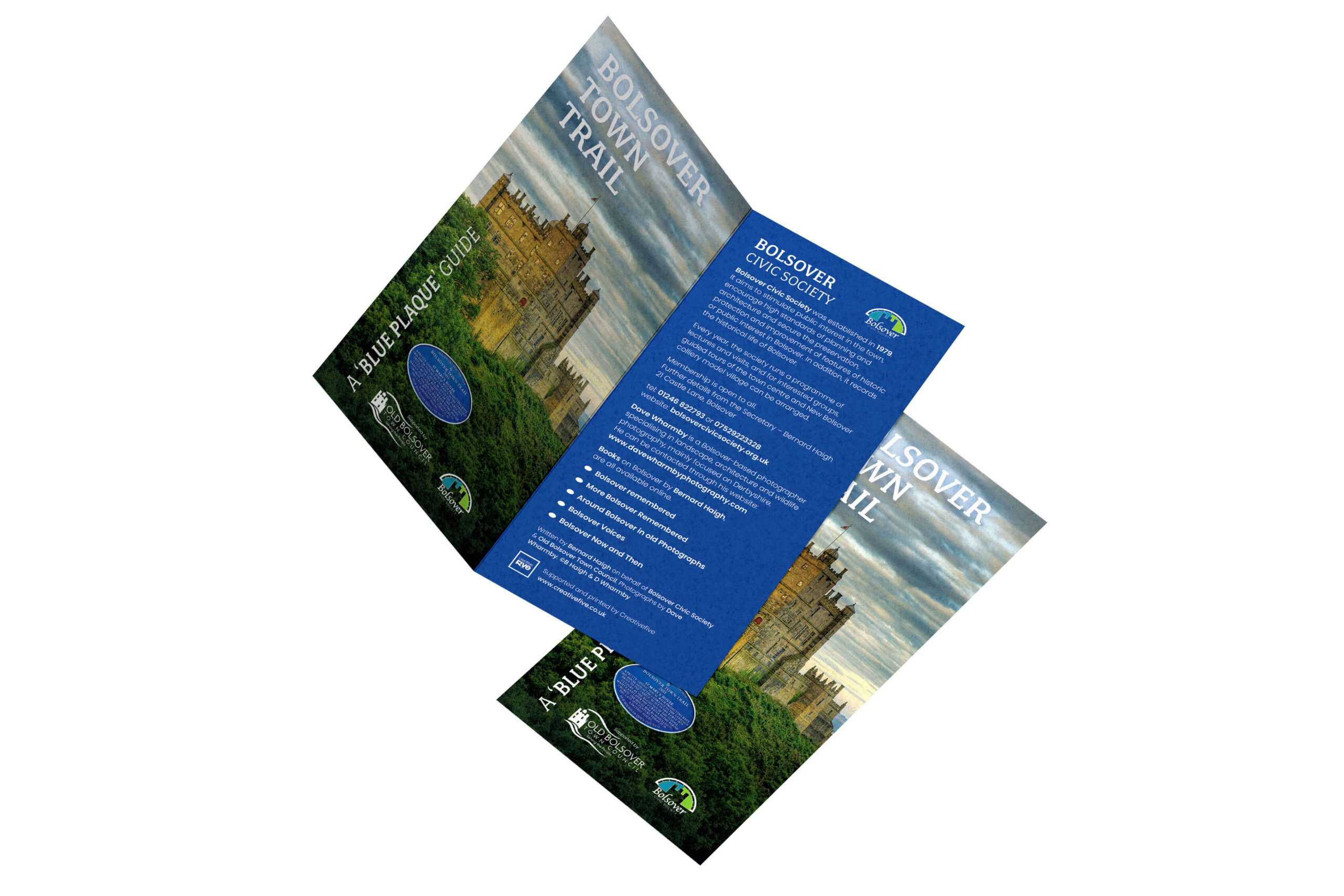
Bolsover Family Town Trail
WALK THE TRAIL AND DISCOVER THE HISTORY AND CULTURE BEHIND THIS HISTORIC TOWN.
Bolsover is full of history and culture. Taking a stroll around this quaint little market town with its castle, churches and medieval monuments provides a treasure trove of historical facts.
Find the Start
Find the Bolsover Town Trail start location using the what3words app:
/// articulated. hockey. snowboard
Or via the following Maps link:

Each tab below corresponds to a point on the Bolsover Town Trail, click a tab to read the next route description…
CASTLE GATES
Starting your journey at the Castle Gates, you will be standing at the original central axis of Bolsover. Constructed in a linear arrangement along a dramatic limestone ridge, Castle Street, Middle Street, Church Street and High Street connect the town with an impressive parish church at the heart of the community.
CASTLE STREET TO THE MARKET PLACE
In medieval times Castle Street was the main street that linked Market Place to the castle, and up until the mid-20th century, it was lined on both sides by beautiful stone buildings, some of which remain today. As you make your way to Market Place, you will be standing in what was, for centuries, the focal point of Bolsover. Being one of the first towns in Derbyshire to receive a market charter, here you would have been able to purchase the famous Bolsover buckles, clay pipes and many other everyday items of the time. Where you now see the Cenotaph once stood a medieval market cross which dominated this area until 1921.
MARKET PLACE 42 – 46
Some of the earliest commercial buildings remaining in the town can be found between 42 & 46. This row of magnesian limestone shops was once part of a much more extensive range of 17th-century buildings. As the town matured during the 18th century, these properties and many others were refaced in stone, typifying how the town developed.
Before leaving the Market Place, take note of the large stone building standing proudly next to Martins World Travel. This property has housed many businesses over the years. At its rear, you will notice a large stone mullioned staircase window which is typical of 18th-century Derbyshire stone houses.
Facing this building and turning left along Middle Street car park will take you through an archway. This was formerly the gateway to a group of Market Place shops that, along with the original arch, were unfortunately demolished. The one you see today was re-erected in the 1970s.
Making your way down the steps towards the post office, glance two doors left and view a large building which now houses Old Bolsover Town Council.
OLD BOLSOVER TOWN COUNCIL
For over one hundred years, this magnificent building has played an important and varied role in Bolsover’s civic and religious life.
Starting out life as a Primeval Methodist Chapel in 1865, it later became the Salvation Army Citadel, Urban District Council Offices and public library before its present-day residence for Old Bolsover Town Council.
BOLSOVER LIBRARY
Glancing to the right of Old Bolsover Town Council and easily recognisable by its steeply pitched pantile roof is Bolsover’s Library. Built in 1976 of local magnesian limestone, it perfectly reflects the character of traditional buildings in the town.
COTTON STREET
Descending from the library towards the town centre, you will see a row of 17th-century cottages with date stones above their doorways. These properties are a perfect example of pre-industrial Bolsover and a time when the town was a myriad of such buildings. Turning right onto Church Street, walk towards what was the entrance to the former CO-OP car park. Opposite, you will notice Church Farm House. This property dates from the mid-18th century and originally had farm buildings to the rear.
Advancing on will take you through the gates and into the graveyard of the Grade II listed Parish Church of St Mary and St Laurence. This beautiful church has a 13th-century tower supporting a broached spire. Severely damaged by fire in both 1897 and 1960, the church has undergone significant renovations. During work on the church, a large 13th-century bell pit was found, which was used for casting the medieval church bell.
Inside the church are two awe-inspiring monuments. One is to Sir Charles Cavendish and his wife and the other is to Henry Cavendish, second Duke of Newcastle, his wife and daughter. Charles was the youngest son of Bess of Hardwick and played a major role in the history of Bolsover Castle. Alongside these monuments is a memorial to mason architect Huntington Smythson and his father, John. Huntington was the grandson of Robert Smythson, the great Elizabethan architect who famously designed the houses at Wollaton, Barlborough, Hardwick and Welbeck.
For lovers of fine Victorian stained glass, the east window at the head of the chancel will not disappoint. This wonderful window commemorates Lady Augusta Cavendish-Bentinck, Baroness Bolsover.
A walk around the graveyard reveals many curious tombs. One of great interest is the individual grave of Thomas Hinde, clockmaker and humourist. Can you spot it?
This church makes for an exciting visit with almost 1000 years of Christian heritage.
If you would like to visit the church and it is closed, please enquire at the vicarage on Church Street.
On leaving the church, make your way through the lych gate on High Street. Turn right towards the castle and cross the road.
Between the undertakers and 51 High Street lies Surprise View. At this hidden little gem, you will see views across the Vale of Scarsdale. Here interpretation signage presents interesting facts about Hardwick Hall, Sutton Scarsdale Hall and New Bolsover Model Village.
Retracing your steps to High Street and continuing towards the castle, make your way to 39 High Street.
39 HIGH STREET – ‘THE PANTILES’
Covered in Virginia Creeper, ‘ The Pantiles’ is a beautiful example of a Georgian house with mid-20th century alterations. Built from local magnesian limestone, this house is typical of the fine Georgian and early Victorian properties that graced Bolsover’s High Street until the mid-20th century.
Moving further down the street will bring you to ‘The Old Meeting House.’
THE OLD MEETING HOUSE
Dated around 1662 and constructed from handmade bricks is a former Presbyterian Church. This building served as the Presbyterian meeting house until 1893, when a new chapel was built, with the old chapel becoming the Sunday school. During its life span, its also been used as a church hall and primary school annexe.
Continuing towards the castle at the junction of High Street and Castle Lane stands St Mary’s House.
ST MARY’S HOUSE
St Mary’s House was built in 1840 by the Duke of Portland for the Head Master of the time. Later this was used by curates to the Parish Church. It is an excellent example of a pretty Gothic house with projecting bay windows.
Taking a slight detour down Castle Lane, just as the road starts to bend to the right, stroll left onto what is known as the Backhills. This lovely landscaped area is the home to one of four Conduit Houses. Many assume these were built as lookout posts that formed part of the castle defence system. However, these were constructed along the line of a natural spring and played a significant role in the castle’s water supply system. No one is sure if they were ever used in a defensive capacity, but all agree that anyone approaching the Castle from afar would probably interpret them as lookout posts.
Returning to Castle Street, follow the road to the castle entrance. Turn left alongside the boundary wall, and go through the black bollards towards the main road. Before crossing, look ahead to the building known as 1A Station Road.
1A STATION ROAD
This is a good example of a locally quarried magnesian limestone cottage with a pantiled roof. Today this serves as a joinery business, but over the years, it has also been a tailor’s and printing workshop.
Continuing your journey cross the A632, and at the side of this property, pass through a further passage which takes you onto Hill Top. Take care, as the road can be hectic. From here, you will see an attractive Methodist Church dating back to 1897.
BOLSOVER ASSEMBLY HALL
Moving a little further on will bring you to Bolsover Assembly Hall. Built originally as a Methodist Chapel in 1866, this is now the main community centre for the town.
Walking down towards the town centre will take you to The Cavendish Hotel.
THE CAVENDISH HOTEL
Bolsover has had no shortage of pubs over the years, but none is a more exemplary example of a late 19th-century public house than The Cavendish Hotel. Situated in the heart of the town, this mock Tudor building was primarily built to serve a growing mining community, which played a significant role in Bolsover’s economic growth from 1899 to 1993.
Crossing the road and heading in the direction of the castle concludes this trail ending at the castle gates. We hope you found it educational and enjoyable.
BOLSOVER TOWN TRAIL
A ‘BLUE PLAQUE’ GUIDE
As you follow the trail you will notice a series of blue plaques which are numbered on the map. These indicate buildings which are of particular historical or architectural importance within the town.
Both the ‘Bolsover Family Town Trail‘ and the ‘Bolsover Blue Plaque Guide‘ have been written by Bernard Haigh on behalf of Bolsover Civic Society & Old Bolsover Town Council. All Photographs by Dave Wharmby.
©B Haigh & D Wharmby